F.A.Q. Locally Produced Low-Emission Nitrogen Fertiliser
With increasing market demand, falling costs for renewable energy and advances in technology, there is a growing case for localised, low-emission N-Fertiliser production
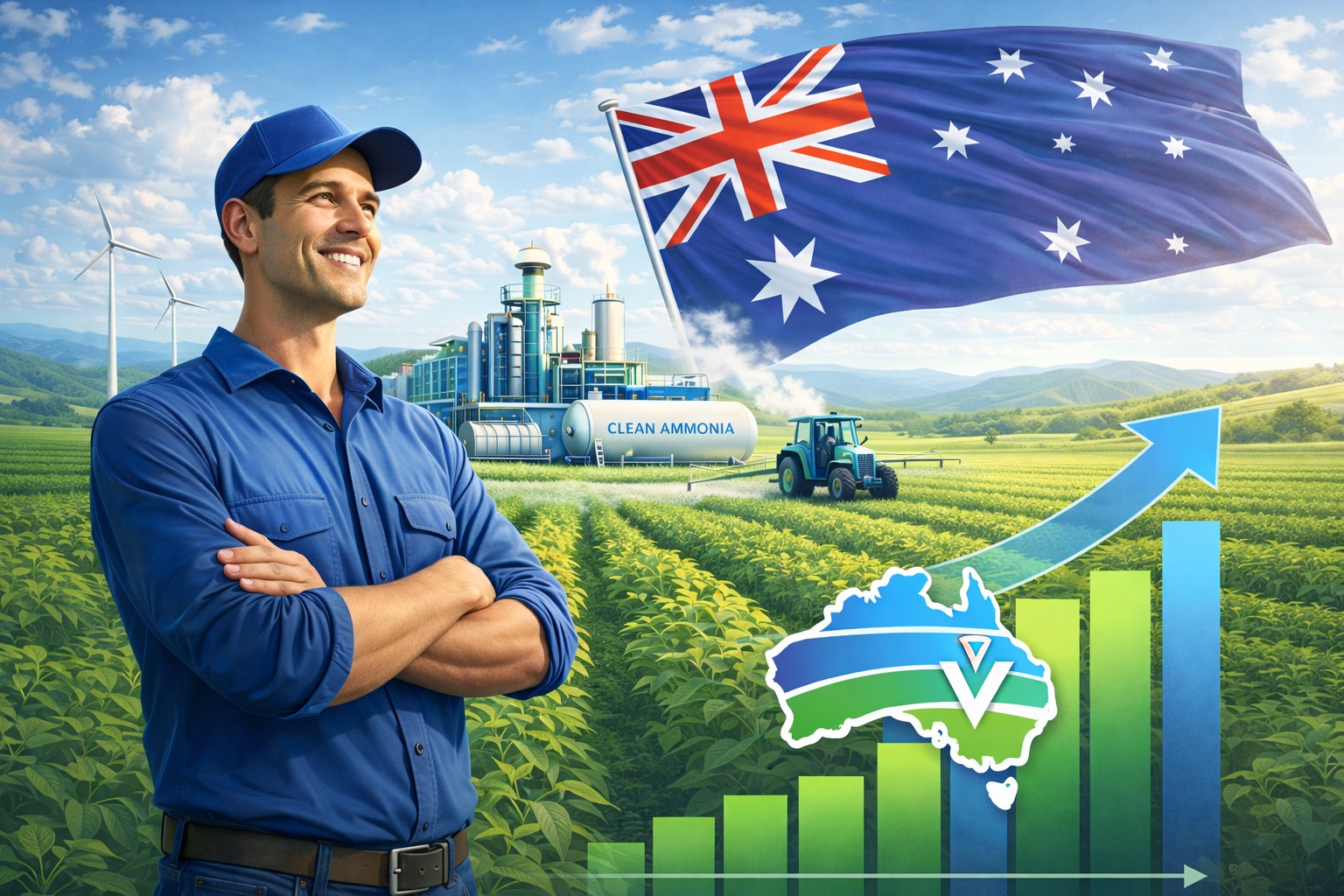
With increasing market demand, falling costs for renewable energy and advances in technology, there is a growing case for localised, low-emission N-Fertiliser production
Nitrogen fertilisers (N-Fertilisers) are the backbone of modern agriculture, crucial for high crop yields and global food security. However, traditional N-Fertiliser production is both energy-intensive and emissions-heavy as it uses fossil fuels as both a feedstock and energy source - such that the emissions from fertiliser manufacture can account for up to 30% of a crop or food product’s carbon footprint[1].
Australia’s heavy reliance on imports (over 90% of Australia’s urea fertiliser is imported[2]) is not only a sovereign food supply risk – it also exposes farmers to supply and cost shocks, and could bottleneck Australian farmers and food companies aiming to access emerging low-emission food markets.
This FAQ explains why shifting to locally produced low-emission N-Fertiliser can benefit Australian farmers, investors, the public, and policymakers. We focus on facts and recent developments – from supply chain vulnerabilities to environmental impacts – and show how cleaner N-Fertiliser production, carbon credits, and carbon intensity certifications play a role.
Locally produced low-emission N-Fertiliser promises real benefits to Australian farmers, Australian business, Australian consumers and aligns with Australian Governmental policy including:
• National Sovereignty and Food Security: Reduces Australia’s strategic dependence on imported nitrogen fertilisers (currently over 90% of supply), enhancing resilience against geopolitical and trade disruptions.
• Economic and Regional Development: Stimulates clean manufacturing, attracts private capital, and creates skilled jobs in regional Australia, supporting national reindustrialisation goals.
• Trade and Market Competitiveness: Equips Australian agriculture to meet emerging low-emission trade standards and Scope 3 buyer requirements, future-proofing local low-emission food demand, food exports and protecting national competitiveness.
• Decarbonisation of a Critical Sector: Enables up to 95% reduction in emissions from fertiliser production—addressing one of the largest industrial sources of CO₂ and aligning with national net-zero targets.
• Efficient Climate Policy Impact: Avoids an additional ~10% of emissions per tonne of fertiliser by eliminating international seafreight, maximizing the environmental return on domestic investment.
Synthetic N-Fertilisers (like urea, ammonium nitrate, etc.) dramatically boost crop yields.
In Australia – as in other farming nations – the use of synthetic N-Fertilisers enables farmers to produce enough wheat, corn, sugar, and other crops to meet domestic and export food demand.
In fact, it’s estimated that roughly half of the world’s population is supported by food grown using synthetic nitrogen fertilisers[3].
One analysis noted that without urea fertiliser, crop production could fall by about 30–40%[2]. Modern agriculture relies on these N-Fertilisers to feed a growing population.
Simply put, without synthetic N-Fertilisers, crop yields and food production would drop significantly, jeopardizing food supply.
• High greenhouse gas emissions in production: Manufacturing ammonia – the building block for most N-Fertilisers – is extremely energy-intensive and typically uses natural gas or coal as feedstock, releasing large quantities of carbon dioxide (CO₂). Globally, conventional ammonia-based N-Fertiliser production emits in the order of 500 million tonnes of CO₂ per year, accounting for roughly 1–2% of total GHG emissions[4][5] – a footprint comparable to the annual emissions of a country like Brazil or Germany. This makes fertiliser one of the largest industrial emission sources.
• Greenhouse gas emissions in transportation: Most of the N-Fertiliser used in Australia is imported via ocean freight with much of it coming from the Middle East, China, South East Asia and North America. Once the N-Fertilisers reach Australian shores they are then transported to the farms where they are used – oftentimes being shipped via road or rail transport using diesel fuel.
In summary, traditional N-Fertilisers contribute to climate change both in their production (via CO₂ emissions from fossil fuels) and in their transport to farms.
Over 90% of Australia’s urea is imported[2]. In 2025, Australian importers brought in about 3.8 million tonnes of urea. This heavy dependence on overseas supply poses several challenges:
• Vulnerability to price shocks: Global market upheavals directly affect N-Fertiliser costs in Australia. In 2021–2022, global urea prices more than doubled in a matter of months, driven by a perfect storm of surging gas prices, export restrictions by major suppliers (e.g. China and Russia), shipping disruptions, and geopolitical conflict (such as the war in Ukraine)[6].
Fertiliser costs are the single largest annual expense for many Australian crop farmers; and they saw their fertiliser bills skyrocket during this period with little warning. Australian farmers who were unable to pass on the increase in their fertiliser costs had their margins severely squeezed.
• Reduced resilience and food security risks: Relying on distant foreign suppliers for a critical farm input is a strategic vulnerability. Any international supply shock – whether due to political instability, trade restrictions, or logistics issues – could threaten timely access to N-Fertiliser, which in turn threatens crop production and national food and economic security. As one industry leader observed during the COVID-19 disruptions, Australia’s heavy import reliance is unsustainable – “Many Australians would be shocked to learn the nation imports 90% of its urea… Positive seasonal conditions meant farmers were set for a bumper crop but faced the worrying prospect they wouldn’t get the fertiliser needed to realise that potential”[2]. We also saw how an export halt of urea-based diesel additive (AdBlue) nearly sidelined freight transport. In short, this situation is a direct challenge to Australia’s agricultural resilience and food security.
• Avoidable emissions from long-distance transport: Shipping N-Fertiliser thousands of kilometers to Australia uses large quantities of fossil fuel, adding “freight” emissions onto the product’s lifecycle. Ocean freighters emit CO₂ and other gases while hauling fertiliser across the globe. By producing N-Fertiliser locally, Australia can eliminate those transport-related emissions entirely. This strengthens the environmental case for domestic production – not only can local plants use cleaner energy, technology and or processes in manufacturing, but they also avoid the significant shipping emissions that come with imports. The result is a lower overall carbon footprint for the fertiliser used on Australian farms (since less embedded fuel was burned to get it there).
• Positioning for low-carbon markets: Importantly, there is a growing demand for verified low-emission food products. Local production of low-emission N-Fertiliser would give Australian farmers an edge by linking agricultural production with domestic clean industry and emerging global market standards. Many of the world’s major food and consumer goods companies are now committing to cut supply-chain (“Scope 3”) emissions – often, more than 90% of a food company’s emissions footprint comes from its supply chain (farms and inputs) rather than its own factories[7]. Fertiliser production can contribute up to an estimated 20–30% of the total emissions footprint of certain food products[8], making it one of the most impactful areas to target for lowering the carbon intensity of food. By supplying farmers with locally produced low-emission N-Fertiliser, Australia can enable its agricultural sector to meet this rising demand at scale. In other words, farmers could demonstrate that their crops have lower embedded emissions without needing to change farming practices – simply because the fertiliser itself has a much smaller carbon footprint. This opens access to emerging markets and premium buyers seeking low-carbon commodities.
By developing local N-Fertiliser production capacity, Australia can stabilise its supply, gain more control over pricing, protect farmers from global disruptions, and enable them to access the emerging low-emission food markets. In essence, local production strengthens food security by ensuring we have the inputs needed for our crops when we need them – without being at the mercy of international market volatility.
Today, ammonia (the precursor for urea and most N-Fertilisers) is mostly made by the century-old Haber–Bosch process coupled with hydrogen from steam methane reforming – i.e. using fossil fuels (natural gas or coal) to provide hydrogen and energy. This traditional route generates a lot of CO₂. In a low-emission process, by contrast, the N-Fertiliser is manufactured using low-carbon technology and/or carbon capture and storage (CCS), sustainably sourced feedstocks, and/or renewable energy instead of fossil fuels[8]. For example, water can be split by electrolysis powered by wind or solar electricity to produce “green” hydrogen, which is then combined with nitrogen from air to create ammonia – with nearly zero CO₂ emissions in the production process. This green ammonia can then be processed into urea or other fertilisers in the usual way, but the upfront carbon footprint is drastically lower.
Thanks to advances in clean energy and industrial technology, it is now feasible to cut N-Fertiliser production emissions by over 95%[1]. In other words, a modern “green” ammonia plant could produce the same fertiliser with virtually no direct CO₂ emissions versus the huge emissions from a coal or gas-based plant.
In Australia, the Good Earth Green Hydrogen and Ammonia (GEGHA) project is a real-world example: it will use on-site solar power to produce low-emission hydrogen and anhydrous ammonia on a cotton farm, replacing diesel fuel in irrigation pumps and trucks and providing fertiliser for their cotton crop[9]. This kind of integrated approach shows how low-emission fertiliser production can be deployed regionally to decarbonise both farm inputs and farm energy use.
The term “low-emission N-Fertiliser” specifically indicates that the product’s manufacturing phase has a much smaller carbon footprint than usual. It’s important to note that this addresses emissions from production; farmers would still need good practices (like precision application and nitrification inhibitors) to manage nitrous oxide emissions from fertiliser use on the farm[10]. Overall, low-emission N-Fertiliser delivers the same crop nutrients with only a fraction of the greenhouse gas output of conventional fertilisers – effectively decoupling crop productivity from high emissions.
• Lower greenhouse gas emissions: Producing N-Fertiliser through low-emission processes (renewable energy, etc.) instead of fossil fuels cuts the CO₂ emissions from the manufacturing process dramatically. This helps decarbonise the agriculture sector and contributes to global climate targets by reducing one of our significant industrial emission sources[5]. Using low-emission fertilisers means farmers can maintain the same yields with a much smaller carbon footprint. For instance, a recent pilot in Germany showed that using “green” (renewable-based) fertiliser reduced the carbon footprint of the resulting grain by up to 30%[8]. In aggregate, such measures aid national efforts to reach net-zero emissions in the coming decades. Additionally, local production reduces indirect emissions from transporting fertiliser over long distances (as discussed above).
• Stronger supply security and price stability: Local production would lessen Australia’s vulnerability to international supply shocks. By making N-Fertiliser on home soil, we improve our supply chain resilience and ensure farmers can get fertiliser when they need it – even if global markets are in turmoil. As Australia’s Minister for Agriculture said when approving a new urea plant, this gives farmers “confidence…they’re going to have urea” season after season, and addresses the “sovereign risks we’ve had around relying on foreign states” for essential inputs[2]. A domestic industry also provides more stable pricing and availability, insulating farmers from extreme price volatility. In short, it’s a buffer against global turmoil – which ultimately safeguards food production and national food security.
• Economic and regional development: Building low-emission N-Fertiliser plants in Australia means investment, jobs, and innovation in regional economies. It creates skilled manufacturing jobs and stimulates supporting industries like clean hydrogen production, renewable energy infrastructure, and engineering services. Over time, Australia can become a leader in green fertiliser technology, opening up new export opportunities. Moreover, strengthening this supply chain at home keeps more economic value inside the country (rather than sending billions of dollars overseas for imports).
• Competitive advantage and future-proofing: As the world moves toward sustainable agriculture, having locally available low-emission N-Fertiliser positions Australian agriculture for the future. Farmers using cleaner inputs can market their crops as lower-carbon, which is increasingly important to both domestic and international buyers. Big food companies and retailers are pressuring their suppliers to cut upstream emissions – in many food supply chains, over 90% of total emissions come from Scope 3 sources (farms, inputs, land use, etc.)[1]. Being able to demonstrate lower embedded emissions (thanks to low-emission fertiliser) will help Australian commodities meet the procurement standards of these companies. There is also growing consumer demand for climate-friendly products: in one survey, 74% of consumers wanted carbon footprint labels on food, and over half were willing to pay a premium for food produced with reduced fossil fuel inputs[8]. Additionally, policymakers are introducing tools like carbon border adjustments (tariffs on the carbon content of imports). By investing in low-emission production now, Australia can stay ahead of these trends, avoid potential carbon penalties on imports, and keep its agricultural sector competitive in a low-carbon global market.
In summary, local low-emission N-Fertiliser supports Australia’s climate goals, makes our food system more secure, and fosters economic growth – all while ensuring farmers can maintain productivity sustainably.
• Life Cycle Assessment (LCA) & transparency: To credibly claim “low emissions” or issue carbon credits, the CO₂ footprint of the fertiliser must be rigorously measured. This is done through an LCA – analyzing all the emissions within a defined boundary of the N-Fertilisers “life” e.g. cradle-to-gate: from sourcing raw materials through to production and up to the point the product leaves the factory. Such analysis yields the product’s carbon intensity (e.g. kilograms of CO₂-equivalent per tonne of product). FarmN conducts ISO-compliant LCA’s for ammonia and all types of N-Fertilisers (urea, nitrates, etc.). An LCA establishes the carbon intensity (e.g. kg CO₂e per tonne of product) of a given N-Fertiliser from a given plant. By comparing it to a baseline, one can verify how much cleaner it is. This scientific, transparent accounting is critical: it provides the data needed for carbon credits, and it gives farmers, investors, and regulators confidence that “low-emission” claims are backed by evidence. In short, an LCA is the foundation that quantifies emissions reductions and ensures integrity.
• Carbon credits for emission reductions: When a fertiliser manufacturer cuts the CO₂ emissions of their production process (for example, by switching from natural gas feedstock to green hydrogen), they achieve a quantifiable emissions reduction versus business-as-usual. It is now possible for new projects looking to produce low emission N-Fertiliser to monetize that difference as carbon credits. FarmN is developing a technology-inclusive carbon-credit methodology for low-emission fertiliser production under the Gold StandardTM registry[9]. This methodology will be aligned with the Paris Agreement and enable N-Fertiliser plants to earn high-integrity, high-value carbon credits for each tonne of CO₂ avoided in making their product[9]. Those credits can then be sold in carbon markets, creating an additional revenue stream that makes low-emission fertiliser more financially attractive. For example, the GEGHA project’s financial modeling to achieve F.I.D. included forecast revenue from the sale of emissions reduction credits (and energy certificates), based on FarmN’s methodology[9]. In essence, the income from selling credits can help offset the higher production cost of “green” ammonia, thereby closing the economic gap with conventional fertiliser. Forward-looking manufacturers can already factor these potential credit revenues into their project plans to improve viability.
• Carbon Intensity Certification: Certification schemes turn LCA data into marketable labels and compliance documents. Australia is developing a Guarantee of Origin certification scheme that will cover hydrogen, ammonia and related products[11]. Similarly, independent carbon-intensity certificates can be issued by accredited bodies to officially recognize a given fertiliser batch as “low-emission” (based on its verified CO₂ intensity). These certifications serve several purposes: they enable trade and market access (for example, helping satisfy import requirements in jurisdictions that demand low-carbon products), they boost investor and buyer confidence (since the product’s credentials are third-party verified), and they may allow producers to fetch premium prices or meet the procurement criteria of sustainability-minded food companies[9]. In short, certification converts emissions data into a practical market passport for low-emission fertilisers.
Together, LCAs, carbon crediting, and certification mechanisms provide financial incentives and accountability. They reward producers for cutting emissions, help consumers and farmers identify genuine low-carbon products, and integrate these products into carbon markets and sustainability programs. This ecosystem of measurement and verification is essential to drive investment into low-emission N-Fertiliser production and to encourage widespread adoption across the industry.
By consulting with organizations like FarmN, stakeholders can get help with conducting LCAs, understanding how to qualify for carbon credits, and navigating emerging standards (such as the Guarantee of Origin scheme or sustainability reporting requirements). In short, FarmN can guide manufacturers and farmers through the process of adopting low-emission N-Fertiliser technologies and maximising the environmental and economic benefits.
For any reader – whether a farmer looking to reduce input risks, an investor exploring green opportunities, or a policymaker crafting sustainable agriculture policy – the move to locally produced low-emission N-Fertiliser is a promising path. It offers a chance to secure Australia’s food production, cut emissions, and stimulate innovation. You are encouraged to contact FarmN Pty Ltd or similar industry resources to learn more about implementing these solutions on the ground. FarmN stands ready to assist with the transition, helping ensure that Australia’s fertiliser future is both secure and sustainable.
Email: info@farmn.com.au
1. Hydrogen Council & McKinsey, “Fertilizing the Future: A roadmap to scale low-emission ammonia fertilizers,” Nov 2025.
https://hydrogencouncil.com/wp-content/uploads/2025/11/Fertilizing-the-future-FINAL.pdf
2. Grain Central, “Green light for WA plant to shore up Australia’s urea supply,” Feb 2022.
https://www.graincentral.com/logistics/green-light-for-wa-plant-to-shore-up-australias-urea-supply/
3. Hannah Ritchie, “How many people does synthetic fertilizer feed?” Our World in Data – Nov 2017.
https://ourworldindata.org/how-many-people-does-synthetic-fertilizer-feed
4. Hydrogen Council, “Global alliance launches LEAF Initiative at COP30 to scale low-emission ammonia fertilizers,” Media Release, Nov 12, 2025.
5. UNIDO, “Launch of the Low-Emission Ammonia-Based Fertilizer (LEAF) Initiative,” COP30 Announcement, Nov 2025.
https://hydrogen.unido.org/news/launch-low-emission-ammonia-based-fertilizer-initiative
6. The Guardian, “What is urea and why does a worldwide shortage threaten Australia’s supply chain?” Dec 8, 2021.
7. WWF Markets Institute, “Incentives at the Farm: How Companies Are Moving from Setting Climate Targets to Delivering on Them,” Aug 2023.
8. Yara International, “Green fertilizers for decarbonizing cereal crops (Germany),” Aug 10, 2023.
9. Ammonia Energy Assoc., “GEGHA project in regional Australia reaches FID,” Jul 27, 2025.
https://ammoniaenergy.org/articles/gegha-project-in-regional-australia-reaches-fid/
10. R. Norton et al., “Securing access to nitrogen for food production – a greenhouse gas perspective,” GRDC Update Papers, Feb 2024.
11. Dept. of Climate Change, Energy, Environment & Water (Aust.), “Guarantee of Origin (GO) scheme,” updated Dec 2025.
https://www.dcceew.gov.au/energy/renewable/guarantee-of-origin-scheme